Innovating Healthcare
Medvista is redefining how hospitals manage care through cutting-edge technology.
Connecting care through innovation and excellence. Partnering for a healthier tomorrow.




Medvista is a leading IT healthcare product company dedicated to transforming healthcare delivery through innovative technology. Our flagship product, VistaMax, is a cloud-native, AI-driven Hospital Information System (HIS) and Electronic Medical Record (EMR) solution that streamlines hospital operations, enhances patient care, and ensures compliance with global standards. We are expanding into India, Australia, UK, Europe, Saudi Arabia, and the USA.


Medvista is redefining how hospitals manage care through cutting-edge technology.
Our solutions are intuitive, fully integrated, and adaptable to diverse care settings.
We focus on transforming both clinical and operational workflows.
Designed with scalability, interoperability, and simplicity at their core.
Our platforms empower hospitals, clinics, and healthcare networks to operate smarter and faster.
Enabling seamless workflows and informed clinical decisions.
We believe better health outcomes start with better systems.
Enhancing patient experience at every point of care.
Our mission is to empower healthcare providers to deliver seamless, patient-centric, and data-driven care by harnessing the power of intelligent, integrated, and innovative digital healthcare systems.

We envision a world where every hospital—regardless of its size or location—operates with unmatched efficiency, empowered by technology that is intuitive, secure, and outcome-focused, enabling caregivers to deliver high-quality, data-informed, and patient-first care without the burden of complex or outdated systems.
Every feature we build solves a real problem.

Built for doctors, nurses, and admins—by listening to them.

Patient privacy is sacred.


We move fast without compromising quality.

We grow only if our clients succeed.

Robust tech, dependable service—trusted daily by our clients.
VistaMax, developed by Medvista, is an advanced healthcare information platform built for hospitals with more than 100 beds. It features over 40 integrated modules, combining Hospital Information Systems (HIS), Electronic Medical Records (EMR), and AI-driven analytics to streamline clinical workflows.
VistaLite, developed by Medvista, is a cloud-based healthcare solution designed for hospitals with fewer than 100 beds and daycare centers. It streamlines patient management, billing, and clinical documentation, making digital transformation simple and effective for smaller facilities.
VistaClinic by Medvista is a smart, cloud-based clinic management system designed for primary care and specialist clinics. It streamlines appointments, patient records, billing, and e-prescriptions, enabling efficient, paperless, and patient-centric care delivery.
VistaPrecision by Medvista is a smart Laboratory Information Management System (LIMS) that streamlines sample tracking, test processing, and result reporting. It integrates seamlessly with HIS/EHR, ensuring accuracy and compliance in modern labs.

VistaPrime is a user-friendly, cloud-based platform that streamlines patient registration, consultations, billing, and health records for clinics and GPs, enabling efficient, high-quality outpatient care.
VistaReach enables patients to receive care from home, offering remote monitoring, virtual consultations, medication tracking, and seamless communication with providers for safe, personalized, and connected care.
VistaGuardian supports long-term care facilities with tools for resident management, medication administration, care planning, and staff coordination, ensuring consistent, high-quality care for elderly and dependent residents.


Led by industry veterans ensuring systems align with real hospital workflows.
Compliant with global standards integrating health IDs and insurance.
Innovation keeps the platform ahead in AI diagnostics and telehealth.

Integrated HIS & EHR platform across Clinical and Financial modules.
Rescuing failed implementations and delivering reliable solutions.
Comprehensive training programs ensuring smooth adoption.
Enterprise-grade open-source tech for flexibility and scalability.

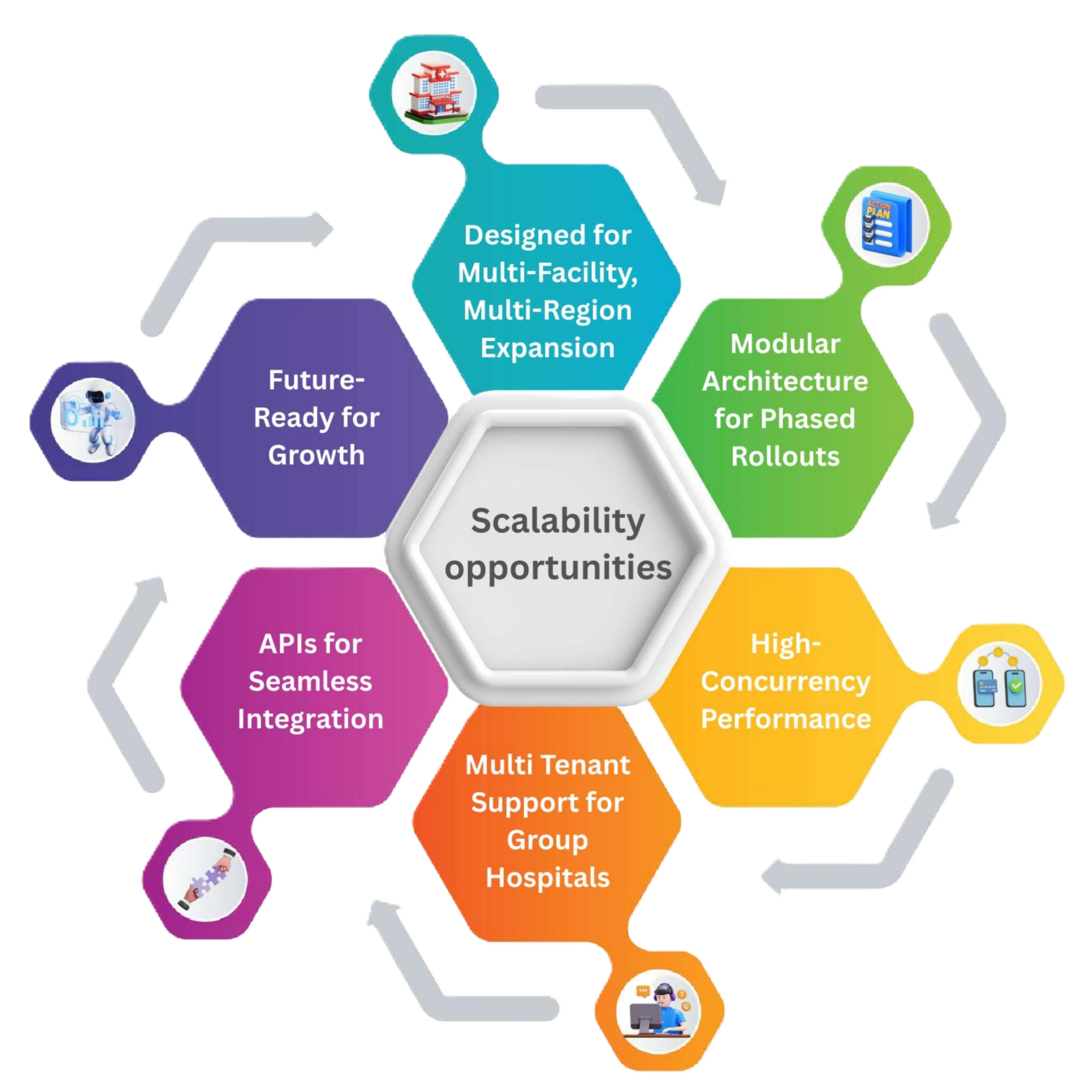
Modular and decoupled design for scalability.

Flexible deployment without vendor lock-in.

Zero-downtime rollouts and quick rollbacks.

Auto-scaling and high availability.

ML-driven predictive insights.

Secure REST, FHIR & HL7 integrations.

Event-driven dashboards and alerts.

Secure CI/CD pipelines.

Supports large hospital networks.

Embedded protection across Secure SDLC and DevSecOps lifecycle.
AES-256 at rest and TLS 1.3 in transit.
Strict identity validation and micro-segmentation.
Granular access based on role permissions.
Frequent audits to eliminate vulnerabilities.
HIPAA, GDPR, ISO 27001 aligned.
Cloud & on-prem hardened infrastructure.
Secure rapid iteration model.
Immutable logs with timestamps.
Redundancy and geo-replicated failover systems.
Round-the-clock technical and functional support across time zones, ensuring hospitals get immediate assistance whenever needed.
Industry-leading Service Level Agreements with guaranteed first-response times under 15 minutes for critical issues.
Each client is assigned a dedicated support team and account manager to ensure personalized, high-touch service.
On-ground support teams and certified partners in key countries provide rapid escalation and hands-on assistance when required.
Reliable infrastructure and responsive support contribute to consistently high system availability and minimal operational downtime.
Well-defined escalation matrix ensures quick resolution of complex issues through tiered expert intervention — from L1 to L3 and DevOps.
Centralized support portal with transparent tracking, knowledge base, and analytics to ensure accountability and visibility for every issue.
Enhancing patient experience at every point of care.
A dedicated innovation lab and consistent reinvestment into research and development ensure the platform stays ahead of industry trends and emerging technologies.
Among the earliest adopters of microservices and cloud-native infrastructure in HIS/EHR – enabling unmatched agility, resilience, and scalability.
Integrated mobile apps, patient portals, telemedicine modules, and remote monitoring enhance digital touchpoints across the continuum of care.

Embedded AI and machine learning models enhance clinical decision support, predictive analytics, and population health management.
Innovative user interfaces powered by voice commands and natural language processing make clinician interaction faster, hands-free, and intuitive.
Real-time dashboards, embedded BI, and self-service analytics empower stakeholders to make smarter, faster decisions at all levels.
Proven to deliver significant cost savings and operational efficiency, enabling hospitals to recover their investment within months.
Flexible pricing options – pay-as-you-grow, subscription-based, or perpetual licensing – that suit hospitals of all sizes and budgets.
Comprehensive suite eliminates the need for multiple vendors or third-party integrations, reducing total cost of ownership.
Flexible architecture ensures transparency, lower vendor lock-in, and long-term sustainability.
Cloud-native architecture reduces infrastructure overhead and allows scaling without upfront capital expenses.
Rapid deployment tools and pre-configured templates lead to quicker go-lives and reduced implementation costs.
High system uptime and efficient workflows result in more productive staff and greater patient throughput.
Transparent pricing with clearly defined deliverables and support terms — no surprises or hidden charges.
Regular feature enhancements and regulatory updates are included at no extra cost, future-proofing the system.



Controlled access to users with unique identifiers for patient and business entities
All access is monitored and logged. all events of changing, deleting, or simply viewing data is recorded and stored, including their respective timestamps and user identifiers
Multi-layered structure with separately controlled access to each layer and communication are encrypted with ssl/tls
Built-in mechanism to protect from data tampering with encryption and digital signatures with ssl/tls
Multi factor authentication
All data is encrypted with transparent data encryption using aes 128/256 cipher
Application is protected with web application firewall layer from all possible attack vectors inclusive of the OWASP TOP 10
All servers are hardened with centre for internet security (CIS) hardening benchmarks
AEGIS augments VistaMax and our suite with an advanced clinical intelligence layer—making workflows safer, faster, and more consistent without replacing clinician authority.

65-year-old male with chest discomfort, elevated troponin (0.08 ng/mL), and mild cardiomegaly on CXR. History of hypertension and daily aspirin. ACS consideration with moderate risk stratification.
ACC/AHA 2014 NSTEMI-ACS guidelines recommend early risk stratification using TIMI or GRACE scores, serial troponin monitoring, and consideration of early invasive strategy for high-risk patients.
Elevated troponin with chest symptoms suggests active cardiac ischemia. Mild cardiomegaly may indicate chronic cardiac remodeling or acute decompensation. Age 65 years and hypertension are additional risk factors.
AEGIS enhances clinical thinking—it does not replace clinicians
Uncertainty is explicit, never hidden or assumed
No prescribing, no orders, no autonomous actions
Every output is structured, traceable, and audit-ready
Most AI systems generate language. AEGIS generates clinical reasoning. Every output is structured around clinical context, severity, evidence, risk, uncertainty, and reassessment.
Traditional systems hide uncertainty. AEGIS exposes it. Every case includes knowns, unknowns, pending data, and reassessment triggers. This mirrors how real clinicians think.

AEGIS does not "try to be safe." It is designed to be safe. Safety is enforced through multi-model reasoning, deterministic validators, terminology checks, guideline grounding, and non-prescriptive framing.
Healthcare runs on standards. AEGIS speaks ICD-11, SNOMED CT, LOINC, RxNorm. This makes AEGIS auditable, integrable, and enterprise-ready.
Accepts EMR data (FHIR/HL7), labs, vitals, imaging metadata, clinician notes. Assumes data may be incomplete, messy, delayed, or contradictory.
Aligns data temporally, normalizes units, identifies missing elements. Nothing is silently assumed.
Consistent, clinician-readable format. Clinical Summary, Evidence, Risks, Monitoring, Uncertainties, Terminology.
Hallucinations checked, unsafe language removed. Confidence gated, invalid mappings rejected.
Multi-model inference interprets severity, contextualizes comorbidities. Aligns findings with guidelines, evaluates risks and red flags.

PDF and image → structured interpretation → actionable next steps. Automated extraction, analyte normalization, pattern detection (e.g. anemia, electrolyte risk), completeness checks, and explainable 'why' trails with strict non-hallucination guardrails.
Converts findings into structured, trackable actions (orders, monitoring, rules) with rationale and evidence. Care team alignment—ownership, urgency tiers, documentation gaps—so nothing falls through.
Separates likelihood from input reliability; surfaces 'needs review' when evidence is insufficient. Must-not-miss safety checks without blaming language—reducing missed critical conditions and standardizing escalation.
When clinical and diagnostic data is normalized and auditable, robust dashboards for utilization, turnaround times, infection control, and quality metrics—without manual reporting burden.